Troubleshooting One Subwoofer
How you proceed depends on your equipment, room shape, and furnishings. A single subwoofer can impose limitations you may not be able to fully correct (I experienced this). The following checklist outlines practical things to test and verify to improve bass performance:
- Setup your microphone and laptop and connect it to your Receiver/Amplifire.
- Reset the subwoofer settings on your receiver/amplifire and subwoofer.
- Find you best subwoofer plaement. Click here for video tutorial.This video will also show you how to setup you MIC and use REW.
- When you find the best Subwoofer position then you can try to play with the list of tip below.
- Remeber to meassure after every change to verify that you are going in the right direction.
If you want to watch a video that will explain most of the tip in my list click here
- Try different subwoofer placements (see examples here)
- Try the subwoofer crawl method
- Move your listening position if possible
- Rotate the subwoofer driver to aim in different directions
- Apply Room Gain Compensation (RGC) if available
- Adjust subwoofer phase
- Verify port tuning or use a sealed/ported configuration as appropriate
- Check polarity (invert if needed)
- Tune parametric EQ using measurements
- Relocate or remove large furniture that affects bass
- Check receiver settings (crossover, level, speaker distance)
- Run Audyssey (or your room correction) calibration
- Disable Audyssey LFC (Low Frequency Containment) if it degrades bass
- Turn off “LFE+Main” if it causes double-bass or overload
- Disable/Enable “Dynamic EQ” and “Dynamic Volume” if they alter tonal balance
This Video vill show you subwoofer placement, how to use REW, and how to read REW data.
The video will explain many of the tips I have mentioned above that can help you in your troubleshooting.
Placement Example
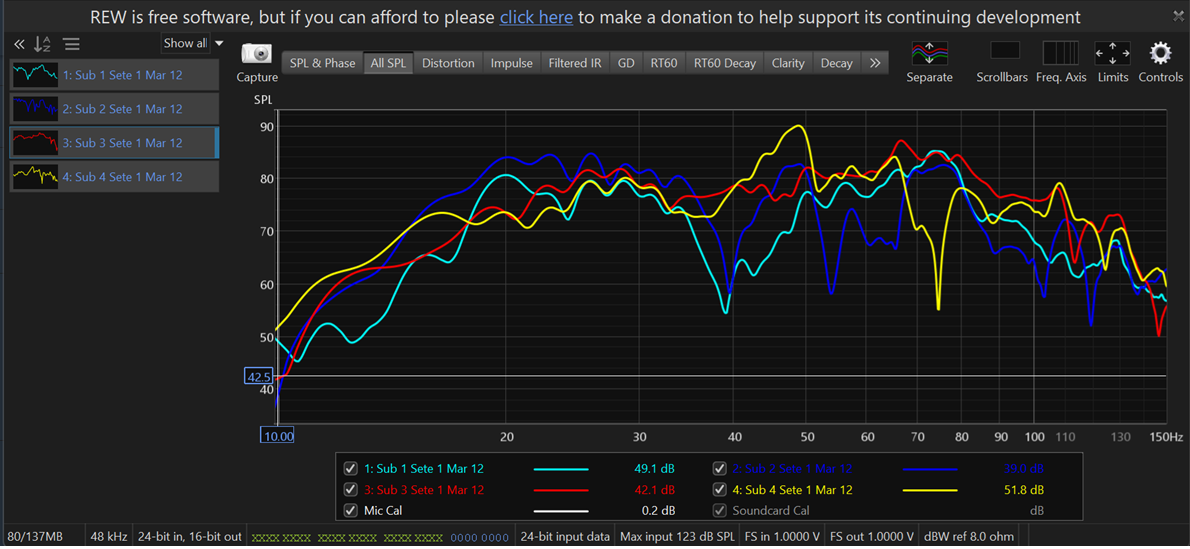
In my system, I have four subwoofers positioned in a distributed layout, with one subwoofer placed in each corner of the room. The measurements shown below illustrate the variation in frequency response and output at the same listening position (Seat 1).
This shows how important the placement can be.